Answer the questions that matter.
Connect the website to the target group’s needs, comparisons, objections and search language.
 Research BuiltRESEARCH · DESIGN · SOFTWARE
Early discovery can be unbranded. Client readouts omit participant names.
We create bespoke B2B websites, original content and useful software around your buyers.
Our London core team draws on 200 individual specialist partners across the UK. If you’re unhappy, our full money back guarantee returns 100% of your website fees, no questions asked, before final approval or authorised public deployment, whichever comes first.

We first met ten years ago. Today, we have founded Research Built around a new shared purpose: create bespoke B2B websites shaped by buyer research, built with care and designed to make a meaningful contribution to our clients’ businesses.
Through our individual careers, we were noticing a decline in the quality of B2B websites: simple template layouts, basic WordPress theme builds, generic copy and little connection to the people the client needed to reach. Important buying questions went unanswered, and the website often had little commercial purpose beyond establishing an online presence.
The problems became clearer over time. Fragile customisations, poorly maintained plugins and fragmented ownership could lead to instability, security gaps and expensive upkeep. Businesses were investing in sites that struggled to attract the right prospects, explain the offer or make a useful contribution to long-term profitability.
That shared concern is why we have now founded Research Built. Our individual expertise comes together in one connected process: understand the market, listen to target buyers, create an original experience and check how it works. The buyer’s questions guide the structure, the proof, the copy and the route to an enquiry.
Today, Research Built creates research-led, bespoke websites with verified research inputs and tested journeys. We bring sector knowledge, competitor insight, original content and senior engineering together to maximise commercial impact and support long-term profitability. Decisions are reviewed, important tasks are tested and the client sees the complete website privately before launch.
As part of the Market Accord community initiative, Research Built benefits from many people contributing some of their time voluntarily. That shared commitment helps keep costs low and makes bespoke websites built around buyer research more affordable. It enables more businesses to access senior expertise, original content and custom engineering through the same coordinated research, testing and review process.
Connect the website to the target group’s needs, comparisons, objections and search language.
Give relevant visitors a clear route to understanding, confidence and a qualified enquiry.
Bring maintainable engineering, security review and ongoing improvement into the delivery process.
Achmed, Deepak, Eugene, Sophie, Dan, Tom and Kieran are among the people behind Research Built, bringing individual expertise into one connected team. Only senior professionals work on your project, each with at least 15 years of professional experience in their own specialism. We assemble a coordinated team of individual partners for their sector knowledge and capabilities. The core stays connected while the specialist mix expands around the research, design, content, software and integration work your project needs.
Listen, observe, investigate the market and turn findings into a clear direction.
Translate buyer tasks into accessible journeys and a distinctive visual system.
Write original explanations and connect search intent to the right answers.
Build responsive pages, useful interactions and a fast, clear browser experience.
Connect workflows, databases, APIs and the systems behind the interface.
Review, test and check the complete journey before it reaches your customers.
Research, original copy, design and frontend engineering form the main team. Software and integration specialists join when the brief calls for connected tools. Quality and security review run through delivery.
Every project has at least one senior professional lead whose web design or web development award is checked during project allocation. We name that lead, explain their role and match the wider senior specialists to the work. Our professionals’ work includes recognition from Orpetron and WaysAwards.
The lead keeps research, content, design and engineering in sync, explains the important decisions and stays accountable for the route from brief to launch.
A marketing website, a customer portal and an enterprise application need different engineering choices. We match languages, frameworks, data and infrastructure to the buyer experience, the operational task and the people who will maintain it.
Semantic HTML5, CSS3 / SCSS, JavaScript and TypeScript form the foundations of a bespoke browser experience. TypeScript makes data shapes and component contracts explicit as an application grows.
We consider keyboard navigation, readable contrast, focus order, form labels and assistive technology. Native HTML comes first; ARIA supports interactions that need it.
Component systems help keep a complex experience consistent. We consider content rendering, performance, interactive state and maintenance when selecting a framework. A focused content website can also use a lighter, purpose-built architecture.
The framework supports the original design and information structure; it does not dictate a template for your business.
JavaScript / Node.jsExpress · NestJS
C# / .NETASP.NET Core · enterprise workflows
PythonDjango · FastAPI · Flask
PHP 8+Laravel · Symfony
Java / GoBackend services · integrations
CMS ecosystemsWordPress · Drupal
We select the backend around the existing systems, the team’s working environment and the application’s needs. Where a CMS helps your editors, the public design, content model and buyer journey are still created for your brief.
Relational databases suit structured records and transactions. Document databases can support flexible data models; Redis can help with caching. We define ownership, retention, access and recovery alongside the schema.
ORM and data access options: Prisma, TypeORM, Entity Framework, Drizzle and SQLAlchemy, selected for the application language and data model.
Forms, customer portals, CRM connections, content workflows and live interfaces need clear boundaries. We document authentication, permissions, error handling and the way information moves between systems.
A cohesive application or separate services can each be appropriate. Capacity planning, database design and operational ownership guide that decision.
Tests address meaningful risks: business rules, important interfaces and the complete user task. We check responsive behaviour, keyboard access, form delivery and integrations, alongside performance and security review.
Code reviews, usability observations and release checks stay connected. A passing technical test and a buyer understanding the offer are different questions; the project needs both.
Version control: Git, GitHub and GitLab. CI/CD: GitHub Actions and GitLab CI, with review and deployment gates suited to the project.
Infrastructure is matched to scale and operating needs. Containers and orchestration join the architecture when they serve a clear purpose. Deployment, backups, recovery and access remain part of the engineering work.
Delivery tools: Jira and Azure DevOps can connect the backlog, sprint planning, reviews and decisions to the client’s working environment.
Partner selection considers commercial delivery, production work and relevant GitHub portfolios alongside Bachelor’s or Master’s study in Computer Science, Software Engineering or Web Development. Demonstrated project experience helps us match the person to the task.
Specialist briefs can call for AWS Certified Developer or Solutions Architect, Microsoft Azure Developer Associate, Certified ScrumMaster (CSM), Professional Scrum Master (PSM I), or membership and qualifications from BCS, the Chartered Institute for IT. Relevant credentials are checked when selecting the project’s specialists.
We also assess architecture decisions, stakeholder communication, code review and mentorship. You should be able to understand why a technical choice was made and what it means for your business.
Your team expands as the work moves from research to prototypes, engineering and release. Agile and Scrum practices connect sprint planning, reviews and improvements. The lead keeps a single backlog, clear responsibilities and a record of the decisions that connect each stage.
Agree the buyer question, business outcome, responsibilities and evidence to review. Select the lead and specialists around that brief.
Connect sector research, competitor analysis and audience observations to content and design priorities.
Review original copy, working prototypes and software increments. Explain decisions, collect feedback and update the backlog together.
Test important tasks, review code and access, walk through the private site with you and agree the approved release.
Tools such as GitHub Copilot, Claude and ChatGPT can support code exploration, generation and refactoring. Engineers review the changes, verify behaviour and use version control and appropriate tests. Tool use respects the project’s information and access rules.
Architecture, buyer research, stakeholder communication and final approval remain human responsibilities.
The project connects research, engineering and client review to a documented quality and security method. Explore the steps, records and examples behind our ISO 9001 and ISO/IEC 27001 processes.
Clear requirements, reviewable work, controlled changes and learning from delivery.
Explore the quality method ↗ISO/IEC 27001 / SECURITYInformation flows, access, supplier choices, backup checks and response planning.
Explore the security method ↗The client frames the challenge. We study the target market, test the route and connect the findings to original content, bespoke design and working software. Explore the complete journey below.
Jump to the nine project phases ↓The people invited to customer research are prospective buyers, decision-makers, specifiers and users from the market the client wants to reach. The client supplies business context and approved facts; audience evidence decides how the public experience should speak and work.
Recruit against the client’s sector, buying role, need and decision context. A clear screening plan keeps the discussion relevant to the real target audience.
Moderated group discussions and individual interviews expose the questions, objections and comparisons people bring before they have seen a design.
Ask participants to find an answer, compare an option or start an enquiry. What they do with a prototype matters more than a preference stated in a meeting.
Record the evidence behind content, navigation, proof, interaction and calls to action. Test the revised route again and measure what happens after launch.
In early discovery, unbranded questions keep the sponsoring client out of the prompt. Participants know they are joining research, while their responses reach the client as findings without their names.
Recruit by role and need. Discuss the problem, comparisons and evidence people seek without naming the client or showing its materials.
Explain the research purpose, consent and any recording before the session. Participation is voluntary, and identifiable details are handled separately from the insight summary.
Group findings by buyer task and decision point. Client readouts use de-identified quotes and observations, with access to any raw material agreed in advance.
Later usability tests may show the client’s brand or prototype. Participants are told what they are testing, and the same consent and reporting safeguards apply.
A template starts with a fixed layout. Our starting point is a business question and the people who must answer it. Research shapes the language, structure, interactions and software before the visual system is built around them.
Sections, hierarchy and common interactions arrive first. The team then adapts its content and workflows to the available pattern.
Buyer questions, observed tasks, content needs and operational constraints determine what each page and interaction must do.
Research reveals the questions, terms and objections to address. Content and navigation can then follow the decision journey.
Forms, calculators, portals and integrations can reflect the way a team and its customers actually complete a task.
Visual language and motion can express the offer, guide attention and make a complex idea easier to remember.
Prototypes and measured releases create a trail from an initial assumption to an observed result and the next change.
These illustrative website states show how one research finding can change the first screen, proof and next action. The design question and test measure sit beside each comparison.
Buyer question: “Can this system meet our line’s output and maintenance requirements?”
Leading solutions for your business.
Learn more ↗Compare output, service access and integration requirements in one place.
Compare systems ↗Put selection criteria and proof before the company story. Test whether a qualified buyer can shortlist a system and ask a specific technical question.
MEASURE → SPECIFICATION VIEWS · QUALIFIED ENQUIRIESBuyer question: “Will this fit our approval process and security requirements?”
One powerful platform for every team.
Book a demo ↗Map reviewers, decisions and audit history around your actual workflow.
Explore the workflow ↗Show how the product works before asking for a demo. Test whether buyers can explain the approval route and locate the evidence their security team needs.
MEASURE → TASK COMPLETION · RELEVANT DEMO REQUESTSThe visual shift follows a specific buyer question. Open each example for the method, page decision and test.
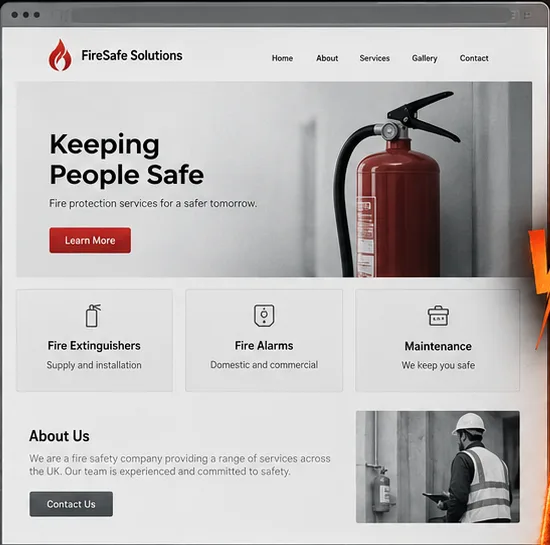
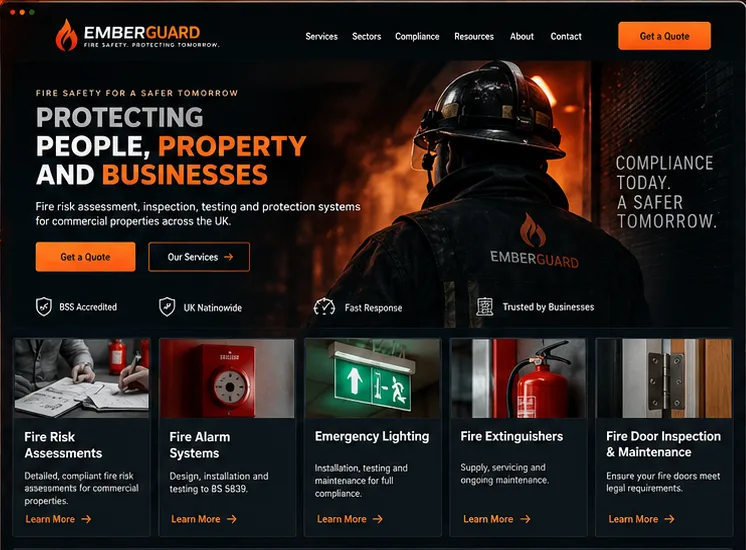
Which fire-safety service meets our building need, and what evidence supports the provider?
See the decisions ↗Social care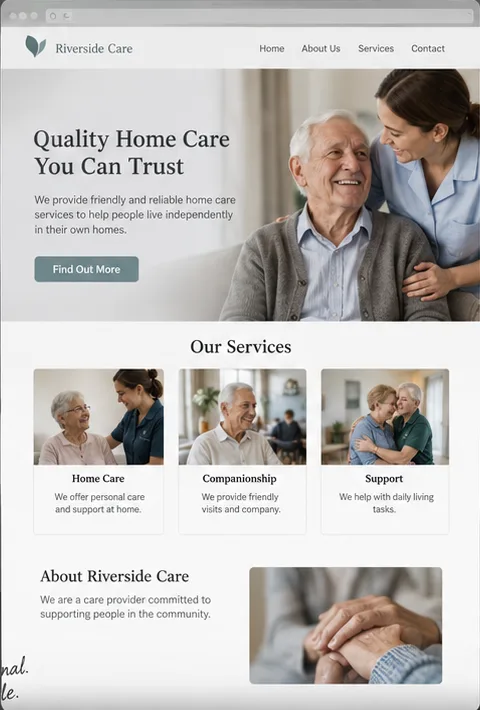
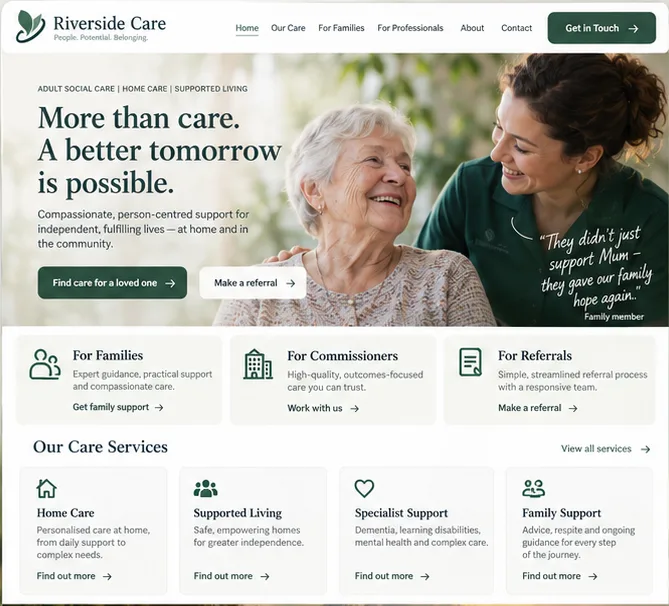
Can a family find the right support while a commissioner finds the service information they need?
See the decisions ↗Ecology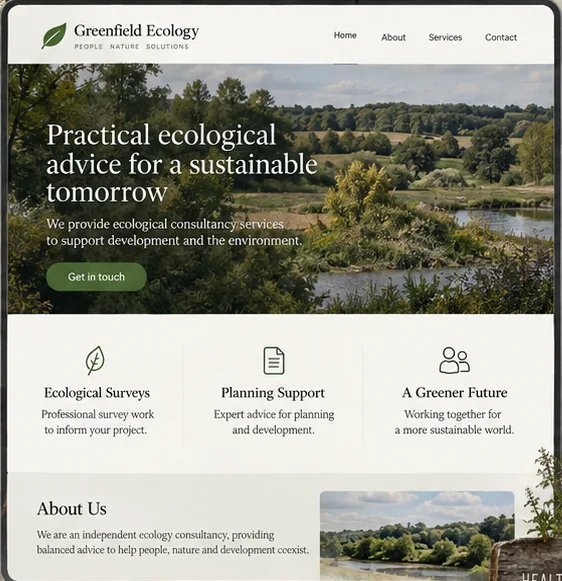
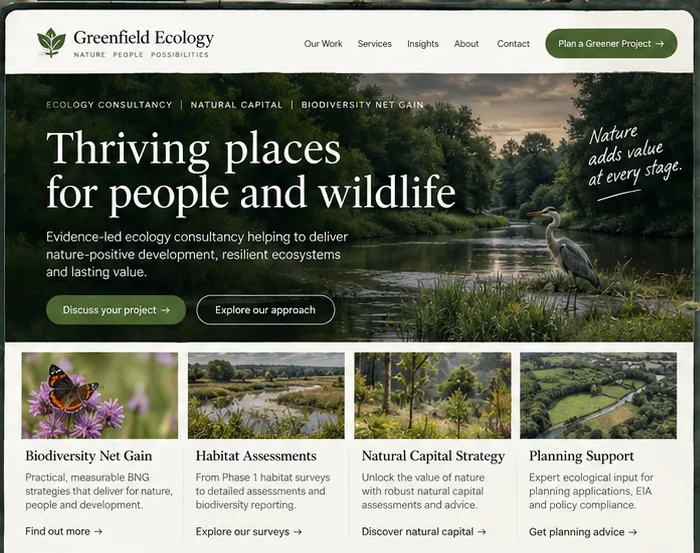
Which ecological service fits our development, and how does the team approach the site?
See the decisions ↗Select a question to see how research changes a bespoke website. Every choice has a traceable reason, a designed response and a practical benefit.
Interviews show how buyers describe the problem and where internal terminology creates confusion.
Headlines, navigation and page explanations use tested buyer language while retaining technical accuracy.
A visitor can recognise their need and find the relevant answer sooner.
Each phase has a question, a method, something tangible to review and a gate that tells the team whether to move forward. Scroll to watch the system change shape.
The client defines the commercial challenge. We turn it into questions that can be answered with people from its target market.
The current customer journey, existing performance, claimed strengths and the decisions prospective buyers must make.
A research brief: target roles, screening criteria, priority tasks, hypotheses and the evidence needed to move forward.
Recruit prospective buyers, approvers, specifiers and users who match the client’s audience. Their own language, questions and actions shape the website; internal opinions do not stand in for them.
Screened participants, consent, moderated buyer discussions, individual interviews, real buying questions and observed workarounds.
Research notes, observed patterns, a buyer-task map and a ranked list of questions the website must answer.
Method reference: GOV.UK research planning ↗ · See a published B2B study ↗
A good design cannot rescue an unclear offer. We compare the language buyers search for with the promises competitors make and test which explanation is understood.
Competitor journeys, search intent, sales objections, proposition interviews, headline comprehension and small landing-page message tests.
A proposition matrix, claim-and-proof inventory, priority segments and a message hierarchy for the first screens.
Turn observed buyer decisions into routes. The site must work for an early prospect, a technical evaluator and someone ready to start a conversation.
Questions and terminology from target-audience research, navigation labels, service relationships, proof needs and enquiry friction.
A task-led sitemap, page objectives, content outlines, prototype navigation and a source trail for important claims.
Art direction does more than decorate. It guides attention, creates memory and makes the complex feel approachable without hiding useful detail.
Visual territories, content density, motion, readability, colour contrast and how different audiences interpret tone.
Brand and interface systems, responsive components, purposeful transitions and image direction tied to the offer.
A static picture cannot reveal a broken path. We build working journeys early enough for people to use, question and change them.
Decision flow, form friction, device constraints, integration needs, service handoffs and the points where visitors hesitate.
Clickable or coded prototypes with realistic content, critical states, error paths and a measurable task set.
Watch representative users attempt the task. Check accessibility. Where traffic and measurement support it, run a controlled A/B test with a clear hypothesis.
Task completion, comprehension, keyboard use, assistive technology, variant allocation, primary metric and guardrail measures.
A findings log, revised prototype, experiment plan and a decision record that separates observation from opinion.
Method reference: Vodafone performance A/B test via web.dev ↗
The final site is a working product: accessible interfaces, maintainable code, reliable content, useful forms and the integrations behind the visible experience.
Hosting, performance budgets, security, data paths, browser behaviour, content workflow and operational ownership.
Production components, tested journeys, responsive layouts, integration checks, deployment plan and recovery route.
A website is complete enough to launch when its critical journeys work and the team can see what happens next. The learning loop continues in use.
Baseline task measures, enquiries, search behaviour, support questions, content ownership and new opportunities.
A verified release, monitoring plan, editorial rhythm, experiment backlog and a record of what each change teaches.
Change the example traffic and enquiry counts. The chart calculates each variant’s observed rate and the relative difference. A live experiment also needs random allocation, a preset duration and a review of sample size and guardrails.
Illustrative inputs for exploring the method; these are not Research Built client results.
Research Built’s own site makes the connection between evidence, visual direction and useful action inspectable.
Published research is connected to its original publisher and the design question it raises.
Explore the data field ↗02 / EXPRESSIONForty visual directions show how different offers can speak in different ways.
Explore the portfolio ↗03 / ACTIONA practical brief builder turns a loose idea into a clearer discussion.
Use the brief builder ↗Our team keeps an eye on changing markets, buyer behaviour, search habits and competing suppliers across 77 sectors. We bring that work together in our in-house sector research database, alongside current studies and the research context in our 2011–2026 reference archive.
Researchers use that shared context to shape the questions, copy, design and tests for your business. Interviews, focus groups, usability sessions and appropriate A/B tests add evidence specific to your buyers. Findings stay connected to the sector, buying role and task, so the whole website works towards the same purpose.
We build privately and take you through three review checks. Request your refund before final approval or authorised public deployment, whichever happens first, and we return 100% of covered website fees, including VAT. No questions asked.
Your peace of mind comes first. We listen to your feedback, refine the details and walk you through your website before you approve it.
We apply the ISO 9001 quality management method and the ISO/IEC 27001 information security method across research, design, development, release and ongoing improvement. Each connects the work to named owners, checks and reviewable records.
We define the buyer task and acceptance criteria, record research and design decisions, review changes, test the agreed journeys and approve the release against its requirements.
We map information flows, assess risks, choose relevant controls and review access, suppliers and changes. Backup and response checks inform the next security review.